Last Friday at 5:40, a chimney of charcoal was smoking on the corner of the patio, Jack was standing exactly as close to it as I'd told him not to, and Ryan was pressing his thumb into the middle of eight raw burgers. That's most Friday nights at our house between Memorial Day and Labor Day, and this weekend is the last of them.
The burgers come off the Weber kettle, a black 22-inch charcoal grill Ryan bought in 2009 for his first rental house in Columbia, the year before we met. It's sixteen years old. The lid has a dent from a foul ball, the bottom vent only closes if you smack it with your palm and the cooking grate is its third. It still makes better burgers than anything else we own, including a pellet grill that cost several times as much.
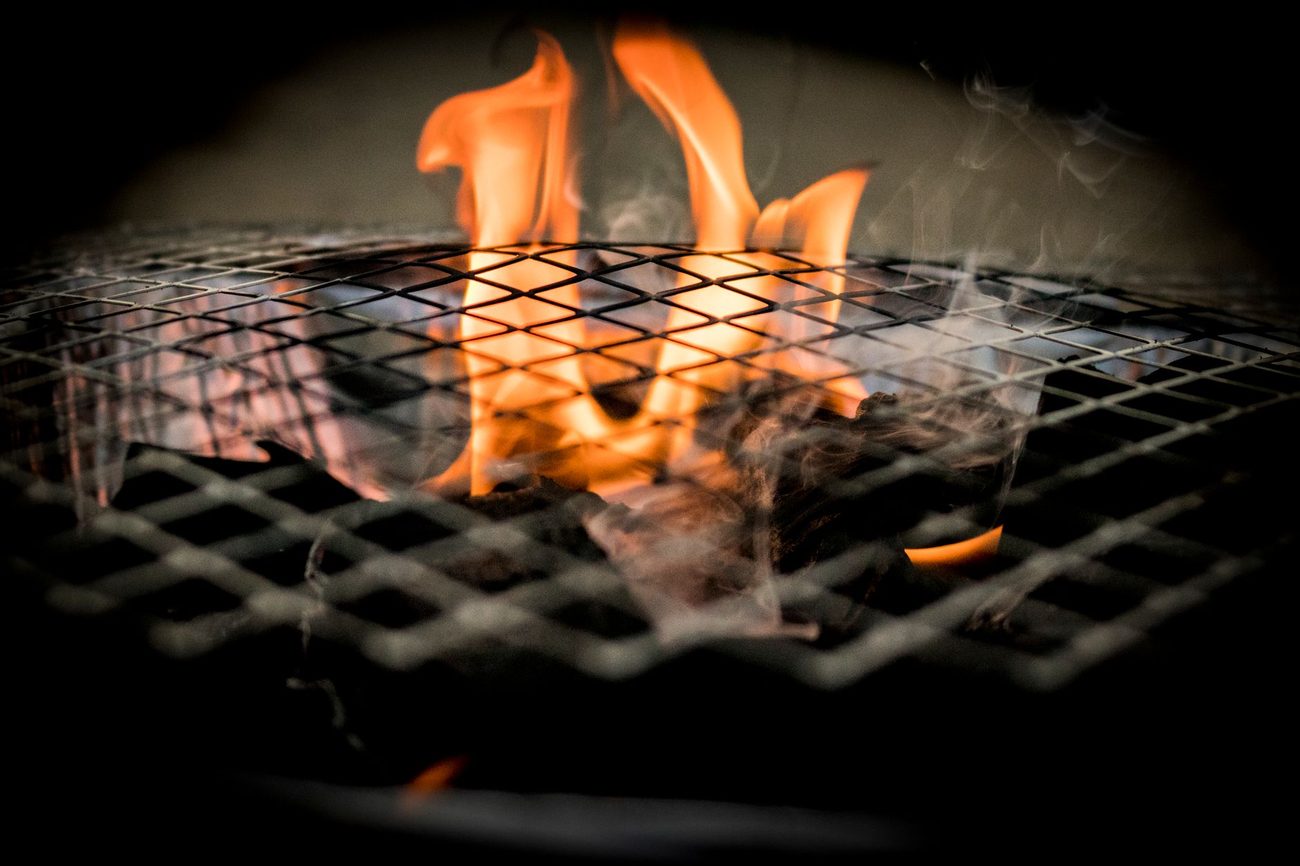
People ask why, since the pellet grill sits right beside it. A pellet grill is basically an outdoor oven with a fan. It cooks with hot moving air and ours tops out around 450°F, which is wonderful for brisket and miserable for a burger. A bed of hot charcoal throws radiant heat you can feel from two feet away, and that's what puts a dark crust on a burger before the middle overcooks. Ryan tried burgers on the pellet grill twice the spring we bought it. They were cooked through and gray all the way around, and that was the end of that.
Ingredients
- 3 pounds 80/20 ground chuck
- 2 teaspoons kosher salt and 1 teaspoon black pepper
- 8 slices sharp cheddar or American cheese
- 8 hamburger buns
- Sliced Cherokee Purple tomatoes, a sweet onion and dill pickles
- Duke's mayonnaise, plus ketchup for Jack
- 1 full chimney of charcoal briquettes
How Ryan grills them
- Divide the beef into eight 6-ounce balls and pat each one into a patty about 3/4 inch thick and a little wider than the bun. Press a shallow dimple in the center with your thumb so it doesn't puff up like a meatball. Keep the patties cold until the fire is ready.
- Light a full chimney. When the top coals are ashed over, about 20 minutes, pour them all onto one side of the kettle. That's the two-zone fire: one side very hot, the other side with no coals at all.
- Put the grate on, cover the kettle for 5 minutes, then scrape the grate clean.
- Salt and pepper the outside of the patties right before they go on.
- Burgers go over the coals. Leave them alone for 4 minutes. Flip once. Never press them.
- After 3 or 4 minutes on the second side, check the thickest one. Ground beef has to reach 160°F. If the crust is done before the middle is, slide the burgers to the cool side, lay on the cheese and close the lid for 2 or 3 minutes.
- Toast the buns cut side down on the cool side while the cheese melts, and let the burgers sit 2 minutes before anybody bites.
The cool side is the part people skip, and it's the part that saves dinner. When fat drips and the coals flare up, the burgers move over until the flames die down. When one patty is thicker than the rest, it gets a few extra minutes there without burning. We call it the waiting room.
The one flip matters more than it sounds. Every time someone presses a patty with a spatula, that sizzle you hear is the juice leaving. I learned that the hard way on this same kettle, flattening burgers for a crowd our first summer as a married couple. Ryan still brings it up.
The beef comes from the meat counter at Publix, where they'll grind chuck while you wait. It was $5.49 a pound last week, more than I remember paying last summer, so three pounds came to $16.47. With buns, cheese and charcoal, Friday burgers run us a little over $3 apiece, and the tomatoes come from our own raised beds.
Jack ranks everything, and Friday burgers are one of the few things in his life that get a ten. Nora takes hers with no onion and extra pickles and finishes it in about five bites. Waylon gets nothing, which he takes personally every single week.
Ryan's position on the whole thing hasn't changed in four years: "The pellet grill is for when I've got all day. The kettle is for when I've got twenty minutes."