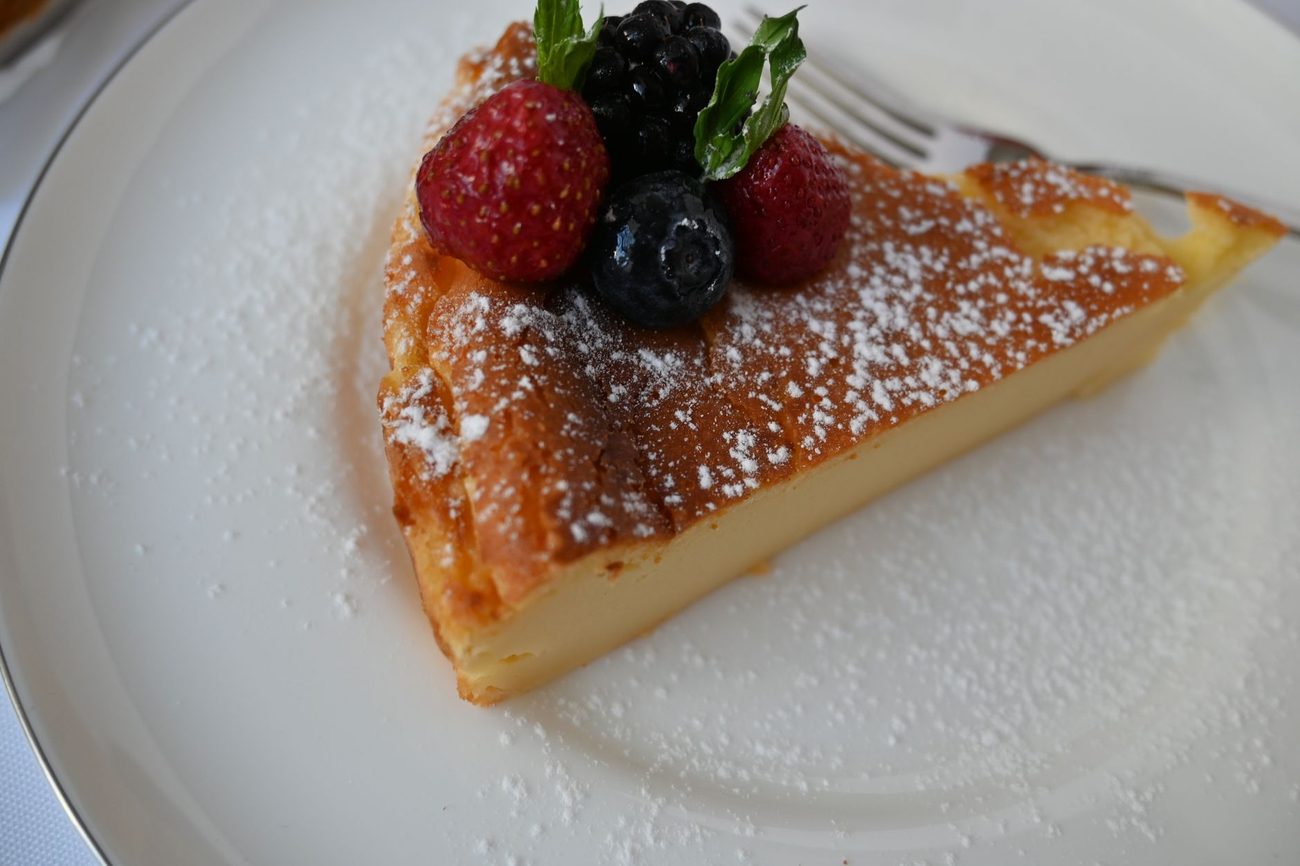
The third pie came out of the oven Tuesday night with a wobble in the middle about the size of a coffee saucer, and I made myself close the oven door and walk away. Jack had practice that night, so it was nearly 8 by the time it went in and close to 10 by the time I came back to look. The top was smooth and pale gold, shiny like a thin sheet of candy. No crack. Nora leaned over it and said, "So the first two were practice?" They were. Delicious practice, but practice.
The card lives toward the back of Granny June's tin box, in blue ballpoint: Chess Pie, 1974. One and a half cups sugar, one stick oleo, four eggs, a tablespoon of meal, a tablespoon of vinegar, a little milk, vanilla. The last line says "moderate oven till done," and that line is the whole problem. Granny knew what done looked like. I had to find out.
Chess pie is about the plainest pie in the South. Sugar, butter and eggs, thickened with a spoon of cornmeal and sharpened with a splash of vinegar so it doesn't taste flat. It was on her table every Easter I can remember, usually next to a coconut cake somebody else brought. This year I wanted hers on ours.
Why the top cracks
My first two pies baked at 350°F, because that's what "moderate oven" usually means on an old card. Both puffed up over the rim like a soufflé, then sank and split across the middle as they cooled. They tasted fine. Ryan ate a third of one standing at the counter and called it "the ugly one I like." But a cracked chess pie looks like a dry creek bed, and I remember hers glassy.
Here's the why, and it's the same thing I tell my eighth graders about scrambled eggs. Raw egg proteins are folded up tight. Heat makes them unfold and link into a soft net that holds the sugar and butter in place, and that net sets gently somewhere around 170 to 180 degrees. Keep pushing the heat and the proteins tighten further, squeeze out moisture and puff up with steam. When the pie cools, that overstretched top has nowhere to go but apart. A lower oven and an earlier exit fix both problems, because the center finishes setting on the counter from the heat already in it.
So for pie three I dropped the oven to 325°F and pulled it while the middle still jiggled. That's the card I wrote and filed behind hers in the box, never in front: 325, pull it with a wobble, walk away.
Ingredients
- 1 unbaked 9-inch pie crust, chilled (store-bought is fine)
- 1/2 cup (1 stick) unsalted butter, melted and slightly cooled
- 1 1/2 cups sugar
- 1 tablespoon fine yellow cornmeal
- 1/4 teaspoon salt
- 4 large eggs, at room temperature
- 1/4 cup whole milk
- 1 tablespoon white vinegar
- 1 teaspoon vanilla
How I make it
- Heat the oven to 325°F with a rack in the lower third. Put the crust in the freezer while you mix.
- Whisk the melted butter, sugar, cornmeal and salt together until it looks like wet sand.
- Whisk in the eggs one at a time, then the milk, vinegar and vanilla. Whisk gently. You want it smooth, not foamy, because air bubbles rise to the top and bake into a spotty crust.
- Set the cold crust on a sheet pan and pour in the filling.
- Bake 50 to 55 minutes. It's done when the edges are puffed and golden and the center two or three inches still wobble like set gelatin when you nudge the pan. If the crust edge browns too fast, cover it with a ring of foil at about 30 minutes.
- Cool on a rack for at least 2 hours before slicing. It firms up as it cools.
One more thing went wrong along the way. On the second pie I got impatient and cut a slice after forty minutes on the counter, and the filling ran across the plate like warm syrup. With a custard pie, cooling isn't optional. It's the last stage of the bake.
Make-ahead: chess pie is better the day after you bake it, so the Easter pie goes in on Saturday afternoon. Once it's cool it lives in the fridge, because it's an egg custard and doesn't belong on the counter overnight. Take it out about an hour before serving so the butter softens back up. If you're out of milk, buttermilk works and makes it a little tangier.
Each pie cost me about $3.50, mostly butter and sugar, because the eggs came from Deb next door. Her hens are laying hard this spring and she takes payment in pie, so she got the cracked one and was gracious enough to pretend she didn't notice.
Easter is a week from Sunday. The pie will sit at the end of the table near Mom's deviled eggs, and I already know Jack will ask for the corner piece, which a round pie doesn't have. Granny would've handed him the crust end and told him that was the corner.